Well, here it is, July - we've been been stationary for nearly a year, and despite my best intentions, I haven't written anything on the blog since October.
It's harder to find things to write about now. That's not to say we haven't done fun and interesting activities, but the flow of life is much different than when we were traveling. The thrill and sense of freedom isn't quite the same. I've been working on being content with local adventures and rediscovering places I haven't been to in years (or never managed to get to before), but it's still not the same as when nowhere and everywhere was my home. I miss many facets of my traveling life. But...
Long term full-time RVing didn't work for us, for a variety of reasons. I'm going to detail a few of them a bit, in hopes that other families dreaming of life on the road who may read this blog think about these facets before embarking on their journeys.
I'm not saying one should not even start - quite the contrary - our trip has been amazing in so many ways, but it was also very difficult in others. I wouldn't give up the experience for anything, but I might have done a few things differently if I would have known.
1. Too far, too fast
We traveled over 50,000 km in 14 months; visited 10 provinces, 1 territory, and 17 (I think) states. That is a lot of ground to cover in what is really a short amount of time. In comparison, one full-timing family took 3 years to visit the lower 48 states. We rarely stayed anywhere more than a week - often only 4 days. The urge to move on and see more, more, more really took it's toll on the family dynamic and created a lot of unnecessary stress. In retrospect there were also many times when we really should have stopped earlier in the day - say before supper time - and been content with how far we had traveled rather than pushing on. If I were to do it again (or do it some more!) I would move much sloooooooooower.
2. Too many new things
Sell the house, move into a trailer, learn how to drive said truck and trailer combination, start homeschooling, get used to all the quirks of being on the road, switch countries (and figure out the logistics of communication, finances, etc) and move, move, move some more! It was quite a learning process, and just when we thought we had figured it out, something else would change. All in all though, I think all of our adaptability skills got deeper...(well, except those days where I would hit my breaking point - and then I had absolutely no coping skills. On those days it would have been nice to have a quiet, padded, soundproof box to hide in and scream when it all got to be too much?... or better yet, we could have just stopped moving for a bit! hmm.. I think I'm starting to see a theme here... slower is good.
3. Internet
This was a huge one. People take their home internet connection for granted. We certainly did! We were so used to having it all the time, and having it fast that it was a shocker to discover that many campgrounds have no or limited internet access. Not being able to get it - for research, communication, schooling, and leisure was difficult for all of us. It became that coveted thing that started to overshadow many things. The US RVers have it easier, because cellular data plans are far cheaper there than here (although it's not as good as it was even a year ago). Figure this one out before you go anywhere. You'll be happy you did.
4. Expectations
I talked of this in one of my earlier posts. I went into our journey with certain expectations and desires. These were not matched by the expectations and desires of the rest of my family. The inevitable disappointment and anger ensued.... and cue fight! (#647...) These conversations were (and are) both difficult and enlightening, and while we were able to work through and compromise on many of them, others continue to be problematic. But that is what life as a family is... give and take and find middle ground that everyone can stand on. If you're planning a trip like this, make sure that those conversations happen before the travel starts. That way everyone is on the same page right from the get-go. Talk to people who have done it, or are doing it. There are Facebook groups, websites, and forums where you can go to ask questions about everything and anything to do with full-time traveling. Use them!
5. Loneliness
We had the wonderful fortune to connect with an amazing group of people in Florida, through the Full-time Families rally. We traveled with or crossed paths with several families during our trip up the east coast - right until we crossed the border back to Canada. It was such a wonderful, eye-opening, and inclusive experience to connect with like-minded families who came from all walks of life. But for much of our travels we were alone, with only each other for company. Sure, there were plenty of friendly people at the many campgrounds we were at, and several short term friends for the kids, but no deep connections.
6. RVing Canadians vs RVing Americans
It makes a difference!
There are extra challenges to being a Canadian full-timing RVer that our neighbours to the south do not have to worry about. Much of it is due to our weather - we must leave the country if we want to RV in the winter (or deal with cold or wet weather), whereas the US residents just head to a different region. It also has to do with our (well actually, the State's) rules. As Canadians, we must return to Canada after 6 months in the States. This meant we had to leave our new group of American friends at the border and travel on without company. Bye friends! We did meet one Canadian traveling family who I still follow online, but we didn't manage to cross paths again after Florida.
Overall the RV culture is different in Canada than it is in the States - I think, due to the whole cold weather thing. We have much more of a summer camping culture where the kids are out of school and people who fill the campgrounds are either on vacation or out for the weekend. It's not quite the same vibe and as a traveler, you are a little bit on the outside of the group who have made that campground their second home (they are definitely friendly, just not quite as inclusive). Now, if we had just stayed put for longer, we might have made those Canadian connections... but that's thoughts for another time.
7. And last, but certainly not least - $$$
Traveling costs money. Traveling quickly and broadly costs more money (especially when you're driving a fuel pig around). How much you spend depends completely on where you are and what you want to do. When all was said and done, we didn't spend any more money than we would have if we had stayed in Airdrie and lived the life we were prior to our traveling (surprisingly our costs really weren't much different between the months in the US and months in Canada). But it was all money out, with nothing coming in. And that's not sustainable (duh!).
This is a huge topic of conversation on the US based forums/ groups. How do full-time families make a living? The answers are endless... construction, seasonal, workcamping, travel nursing, IT, web-based businesses, home based businesses, consulting....
But when that question is asked a little differently "How do Canadian full-time families make a living?" the answers dry up.
We, personally, never did figure out how to earn an income and travel, which is a bummer, because I would have loved to have figured this one out. (I'm still investigating this one with thoughts on the future, though.)
One further point to consider: travelers also can't forget the different country - different money part of the travel equation. Entering the US for the winter means dealing with the exchange rate. When we went to the US in the fall of 2013 the Canadian dollar was on par with the US dollar. When we crossed the border the Canadian dollar was worth 90 cents US. As I type today, the Canadian dollar is only work 76.5 cents. That's an ouchy, painful in the pocket book kind of difference which definitely makes one closely examine their cross-border spending. Certainly something to consider if future travels take you outside your country's borders.
So that's it. I hope you find these thoughts helpful in planning your own adventures, be they big or small, local or far-flung.
And never be afraid to embrace something that others consider somewhat unconventional.
It may just change your life forever.
Thursday, 23 July 2015

Friday, 31 October 2014
The people make the place
I mentioned in my previous post that I really enjoyed Nova Scotia, and I think a large part of that was due to the people.
Nova Scotians (at least the ones we met) are so friendly and helpful and seem genuinely pleased to share their culture and lives with whomever they meet. It really makes a difference when you're traveling, especially with a great big fifth wheel (have I mentioned lately our 55' long rig set up?).
Over and over again we encountered this attitude, and it definitely made our travels around Nova Scotia memorable and comfortable. (A dad we met in PEI, who was from NS, remarked "Oh yeah, Nova Scotian's are friendly. They'll open their house to you and give you the keys to their car...")
 In Yarmouth, we parked our big rig in the small Visitor Info Center parking lot. Lily immediately received a Nova Scotia pin (which we still have) and the helpful staff gave us a walking map of town and directed us to the wharf where a fisherman was demonstrating how to make nets and lobster pots. With their Living Wharves program, Yarmouth employs fishermen in their off-season to demonstrate a variety of skills to inquiring tourists, and spread knowledge and understanding about their lives. The kids got a bit squirrelly, but I found it fascinating to watch the net making process. Kind of like braiding with a great big chunk of rope! (Morgan would rather balance on top of the low rail around the wharf, and give his mother a minor heart attack thinking I'd be fishing him out of the water at any moment.)
The fellow also spoke of the concerns and life of a fisherman, and noticing that my kids were full of energy, directed us to some of the good sights and activities for kids & adults alike that were in the area. (The walking tour of the Sea Captain's houses might not excite the kids, but the walk through Yarmouth's old streets is easy - even for little tired feet- and the big, beautiful old houses are an interesting mish-mash of styles.)
 The next day we drove to Pubnico, to visit the Historic Acadian Village of Nova Scotia, a small village reconstruction, with original buildings from the region, staffed by locals (in costume) who are more than happy to share their history with inquiring minds. The harbour is beautiful, and the combination of greenery and ocean waves made me want to sit and stare at it all forever. (I may have to move to the ocean some day. Bob's in agreement with this... We also were here in late June. It might not be so nice in January!)
Morgan did his usual running around without appearing to take in any of it, but Lily charmed the fellow who was at the boat shack with endless questions and came home with a handful of wooden lobster pegs. (I've finally them out of her carseat into the house. Sharp bits of wood do not belong in the back seat of the car! Especially when they are used on her big brother.) Everyone working at the Village wanted to make sure we saw every last bit of the village, and then offered up some ideas for things to do after we were done there (directions too).
 After we finished up our visit to the Village, we headed a short ways down the road to Dennis Point Wharf. Here we played Boat Name Bingo from an area brochure we had picked up. Basically, you go to the harbour and try to find boats with different characteristics and make a Bingo! from the sheet (colors, names, radio antennae, accessories,etc.). Sound silly? Actually it was great fun. Morgan even remarked. "Okay, I thought this was going to be lame, but it's actually kinda fun." (See! I told you so.)
Then we drove on to Lunenburg, where the people were even friendlier. We had planned only two days there, but a mechanical failure on our landing jack as we were packing up to go forced us to stay until it was repaired. The campground owner helped us find blocks to jerry-rig a way to hold up the trailer, his wife brought us some fresh fish to try out and they extended our discount (we used Passport America) to cover our whole five day stay, rather than just the original two (which they did not have to do!). They definitely went above and beyond the call of duty and we greatly appreciated it. The local RV dealer even managed to squeeze us in that week (unlike the others we called around Halifax who had a 2-3 week lead time). The delay was a blessing in disguise, really, as it allowed Morgan and I to finish up his school year without adding the stress of moving to it, gave us a chance to explore more of the area and let us just settle a bit into living mode, rather than travel mode. The kids even had a chance to set up a lemonade stand (which Lily had been wanting to do for weeks), and the long term residents were happy to buy a glass (for much more than the requested fee - these kids do well on their money making schemes! In case you wonder what happened to their earnings, all the money was spent on chocolate. I even got a piece!)
I've already remarked that my memory of details is fading, but I'm pretty sure that the friendliness of the people we met in this province will stick with me and influence the way I think of Nova Scotia forever. The people really do make the place.
Nova Scotians (at least the ones we met) are so friendly and helpful and seem genuinely pleased to share their culture and lives with whomever they meet. It really makes a difference when you're traveling, especially with a great big fifth wheel (have I mentioned lately our 55' long rig set up?).
Over and over again we encountered this attitude, and it definitely made our travels around Nova Scotia memorable and comfortable. (A dad we met in PEI, who was from NS, remarked "Oh yeah, Nova Scotian's are friendly. They'll open their house to you and give you the keys to their car...")
 |
| Some of the houses |
 |
| This is his "we are not impressed" face |
 |
| Listening to fishing stories |
 |
| In the blacksmith's shop |
 |
| Bob goofing around with a giant lobster! |
 |
| Science experiment with the blocking in the background |
I've already remarked that my memory of details is fading, but I'm pretty sure that the friendliness of the people we met in this province will stick with me and influence the way I think of Nova Scotia forever. The people really do make the place.
Monday, 20 October 2014
Remembering: Nova Scotia's Fundy side
Looking back at the blog, you'd think that we went straight from New Brunswick to PEI in June, but that isn't true. We actually spent two weeks in Nova Scotia, looping around the western and southern shores.
I can't quite remember why I didn't write about it, as I know I thoroughly enjoyed those two weeks (I think I was behind - as usual - and still writing up NB, or possibly I decided to live in the moment rather than focus on recording it all, or who knows!). But, I'm finding that already my memories, and my knowledge of where we were when is getting fuzzy and I Need to write it down.
Preserve our time there. Share it.
I'm also still having more trouble settling into stationary life than the rest of my family. The urge to be on the move is strong, and getting stronger as the days shorten and get cooler (although right now is really beautiful for mid-October).
The recent words of my Grandma ring strong in my head... (paraphrasing) "While no adventures are available to you right now, maybe you should write about them." Good advice!
And so, here goes..
 It's a short drive from Moncton, NB (where we were) into Nova Scotia. The boundary between the provinces is really noticeable as the rolling land gives way to a flatter windy area that makes you believe that at one point in our geological history this section of Canada really was smashed together and then tried to rip apart. The wind blows strongly through here, and windmills dot the landscape.
Bob had contemplated going on a tidal bore jet boat tour on the Subenacadie River, near Truro, but by that point we were all pretty Fundy phenomenon'd out. The enormous tides are very cool (up to 50 feet!), but after a while, it loses its novelty.
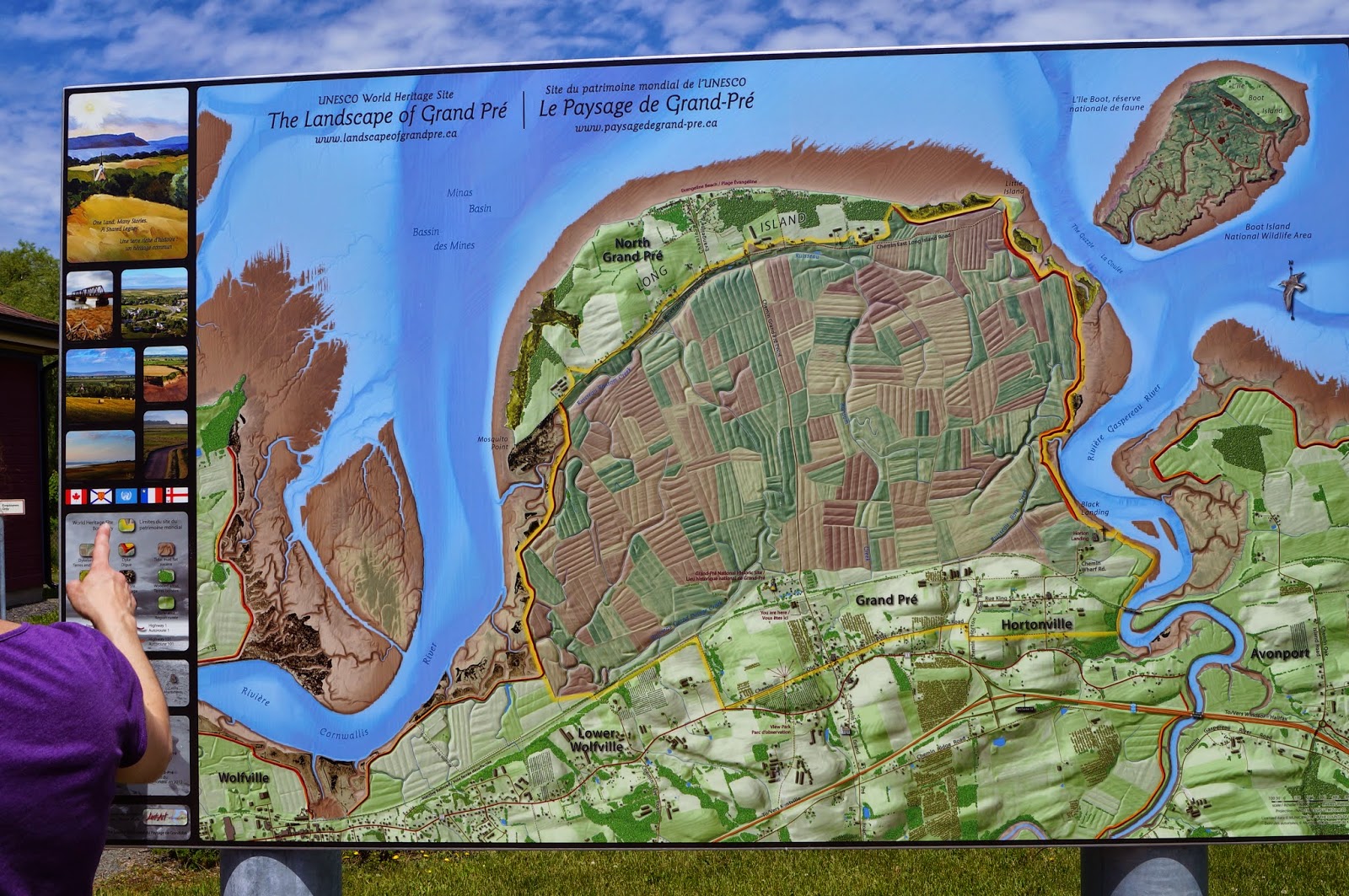 We chose, instead, to head towards Grand Pre (NHS), for a history lesson. Morgan had been studying the Acadians in Social Studies and Nova Scotia is a great place to learn about them & their history. The Acadians were settlers from France who came to the East coast of Canada looking for a simpler life (back before Canada was Canada, and the British and French fought constantly over the land). They utilized the poor soils of the coastline - building up solid land from the tidal flats using ingenious dikes and a whole lot of labor and community cooperation. A really amazing feat, when you look out on the land they created.
However, in the conflicts between the British & French, these people were caught in the middle, and ultimately forcibly exiled from their homes (going many places, France, other parts of Canada, and the US - including Louisiana, where their descendants are known today as Cajuns). Some eventually returned to Canada, but rarely were they able to come back to the land they had worked before. Their history is both sad and fascinating, and the people who are of Acadian descent here are extremely proud of their tenacity, and spirit.
The history is evident in the language - Nova Scotia is truly bilingual, and you are as likely to hear French spoken as English. The schools teach both, and so the children's French/ English sounds different than you might hear in Quebec - no accent. One little girl who was speaking to Lily in French, quickly realized that Lily didn't understand and seamlessly switched to English mid-sentence.
It's the way I imagine Canada should be. Both languages, spoken by all - no politics or anything attached. I've stated that fact to people since then, and have been met with all sorts of reasons why this is a bad idea. Ah well, everyone is entitled to an opinion.
Onwards to Digby, the scallop capital. Chances are good that when you purchase Nova Scotian scallops they'll have come from around here. Bob had some & thought they were delicious. Everything tastes better at the source!
Our main reason for going to Digby was to go on a whale watching tour, hoping to see the famous whales of the Bay of Fundy.
A little tip for everyone - don't go whale watching the day after a storm (especially early in the whale watching season). The whales will have scattered, and the waves are still strong (as my stomach is not). An unfruitful trip, but the scenery on the drive down the Digby Neck was beautiful enough to make up for the disappointment of not seeing our much longed for aquatic denizens. (Bob calls this day the no whale watching whale watching trip.)
We chose to take our tour out of Brier Island, the southern most island on the Neck. It takes two small vehicle ferries to reach, both of which we caught in perfect time. I would have loved to stop and admire the scenery of the drive (there was a cove called Beautiful Cove, and it truly was), but the ferries are timed such that you need to keep moving if you want to catch the next one (or wait an hour). It was here, on the island, that the Fundy tides impressed me most. When we headed out on our tour we walked down a long, steep stairway ramp from the dock to board our boat. Upon our return we stepped directly from the boat onto the dock. No fanfare. No signs saying look how amazing this is. Just part of the daily life of an island who's entire culture revolves around the ocean.
 While staying near Digby we drove to Annapolis Royal to see sights both modern and historical. First stop, the Tidal Generation Station. This innovative power plant uses the tides to generate power. It is small in scale, only providing enough power for 4500 of Nova Scotia homes, but it uses natural forces to provide us energy (which I always find very cool). In many ways, this plant is a research center, as only a few of these types of facilities exist in the world, and it's the only one that deals with such tidal extremes (both in size and water velocity). It's free to tour the upper level, which has many interpretive panels and displays and when available, a tour down under the plant to the turbine, to learn more about the inner workings of the plant can be taken. Bob went down to see the turbine, while I stayed on the upper level with the kids. The government run plant is very aware of its environmental obligation to protect the environment and learning about how they are working and learning to balance the people's energy needs while considering nature was very heartening.
 Onward, to the history lesson... Near Annapolis Royal is Port-Royal, site of the first French settlement in North America. Port-Royal was where French explorer Samuel de Champlain put his first foothold on the continent in 1605, an act which influenced the make-up of all of Canada (he also founded Quebec City). All these firsts along the east coast of North America get confusing - and it seems quite complicated as everyone vies for first... St. Augustine, FL was the first European (Spanish) settlement, and Jamestowne, Virginia was the first English (I've heard it stated as the first European north of Florida, which isn't strictly true - it was actually settled later than Port-Royal, but their settlement was permanent, whilst Port Royal's settlement was temporary, and was abandoned after it was burnt down - by people from Jamestown! The French & English didn't want to share, apparently.) We've visited all during our trip, and learning each facet has certainly fleshed out the continent's history in a way no book ever could have (woo for hands on learning!).
The rebuilt fort is very authentic looking, from the hewn wood walls, to the scraped hide windows, it looked very much like the fur trading forts I've been to in Alberta (Parks Canada did an awesome job in the rebuilding). Many of the items there were touchable (its so nice when you go to a place and don't have to repeat to the kids "don't touch" until it becomes a tiresome, limiting mantra), and the kids and I were especially interested in the blacksmith tools. (I mean, who doesn't like to pound on stuff with a big ringing hammer!) The entry fee is quite reasonable (around $10 when we went), and I felt it was well worth the visit.
We polished off our trip to Annapolis Royal with a tour of Fort Anne (NHS), a walk through the graveyard for Lily and I, and a drive through town to see the historic buildings (oh, and a stop at the grocery store, cause it can all be fun and games!).
And then we said goodbye, to the Fundy coast and headed to Yarmouth, at the tip of Nova Scotia. Although we were not to return to see more of the tides, we came away with lots of pictures, a new found understanding and appreciation of our country's history, and Morgan's red-mud stained socks (which are still nicely stained today).
I can't quite remember why I didn't write about it, as I know I thoroughly enjoyed those two weeks (I think I was behind - as usual - and still writing up NB, or possibly I decided to live in the moment rather than focus on recording it all, or who knows!). But, I'm finding that already my memories, and my knowledge of where we were when is getting fuzzy and I Need to write it down.
Preserve our time there. Share it.
I'm also still having more trouble settling into stationary life than the rest of my family. The urge to be on the move is strong, and getting stronger as the days shorten and get cooler (although right now is really beautiful for mid-October).
The recent words of my Grandma ring strong in my head... (paraphrasing) "While no adventures are available to you right now, maybe you should write about them." Good advice!
And so, here goes..
Bob had contemplated going on a tidal bore jet boat tour on the Subenacadie River, near Truro, but by that point we were all pretty Fundy phenomenon'd out. The enormous tides are very cool (up to 50 feet!), but after a while, it loses its novelty.
 |
| Checking out Periwinkles in the Grand Minas basin |
 |
| Admiring the expansive gardens |
The history is evident in the language - Nova Scotia is truly bilingual, and you are as likely to hear French spoken as English. The schools teach both, and so the children's French/ English sounds different than you might hear in Quebec - no accent. One little girl who was speaking to Lily in French, quickly realized that Lily didn't understand and seamlessly switched to English mid-sentence.
It's the way I imagine Canada should be. Both languages, spoken by all - no politics or anything attached. I've stated that fact to people since then, and have been met with all sorts of reasons why this is a bad idea. Ah well, everyone is entitled to an opinion.
Onwards to Digby, the scallop capital. Chances are good that when you purchase Nova Scotian scallops they'll have come from around here. Bob had some & thought they were delicious. Everything tastes better at the source!
Our main reason for going to Digby was to go on a whale watching tour, hoping to see the famous whales of the Bay of Fundy.
A little tip for everyone - don't go whale watching the day after a storm (especially early in the whale watching season). The whales will have scattered, and the waves are still strong (as my stomach is not). An unfruitful trip, but the scenery on the drive down the Digby Neck was beautiful enough to make up for the disappointment of not seeing our much longed for aquatic denizens. (Bob calls this day the no whale watching whale watching trip.)
 |
| Looking at a the south end of town from the boat |
The rebuilt fort is very authentic looking, from the hewn wood walls, to the scraped hide windows, it looked very much like the fur trading forts I've been to in Alberta (Parks Canada did an awesome job in the rebuilding). Many of the items there were touchable (its so nice when you go to a place and don't have to repeat to the kids "don't touch" until it becomes a tiresome, limiting mantra), and the kids and I were especially interested in the blacksmith tools. (I mean, who doesn't like to pound on stuff with a big ringing hammer!) The entry fee is quite reasonable (around $10 when we went), and I felt it was well worth the visit.
 |
| OMG! I didn't think they made this stuff anymore! |
And then we said goodbye, to the Fundy coast and headed to Yarmouth, at the tip of Nova Scotia. Although we were not to return to see more of the tides, we came away with lots of pictures, a new found understanding and appreciation of our country's history, and Morgan's red-mud stained socks (which are still nicely stained today).
Wednesday, 17 September 2014
Off the road
Well, we've officially moved out of the RV, and into a rented townhouse.
Our home for the last 14 months now sits empty. It makes me sad.
But, fourteen months of continual travel (and deferred repairs) has also left its mark on the trailer that really must be addressed. It needs some major TLC, which will be easier to deal with now than if we were still living in it.
The front of the main slide is rotten from water damage. We have fought with the slide the entire time - it never wanted to come in tight enough, and I suspect water got forced in every time we traveled in the rain. The Florida ant infestation probably didn't help.
And recently, the very front wall in the kids room is flexing - it's not supposed to do that! (Boy, oh boy, I hope it's not a structural issue.)
Oh, yeah - and that darned rear-end that we mangled in Nova Scotia!
Even knowing this, I feel a little lost away from it.
Everyone (except me) has fallen back into the stationary life with open, happy arms.
The kids are both ecstatic to be back in public school (almost shockingly so). My grumpy Lily (who always slept in as long a she could, and dragged her feet to get ready for the day in the trailer) gets up each day eager to go.
Bob is happily ODing on TV and internet and claims he is never going in the RV ever again. (sigh).
Even the cat seems happier. She's exploring the whole place, not stuck in one room, and has so many more places to hide when Lily decides to come pestering her.
None of them says much about our time traveling.
Guess the nomadic life was just not for them.
For me, though... I've discovered I'm a gypsy at heart. I get flashes of the places I've been at random moments during the day, and yearn towards many places I haven't been to (and one's I have). I don't know if I'll ever be entirely comfortable being stationary ever again.
So what's a grounded gypsy girl to do?
Saturday, 23 August 2014
Fast Forward
I left the blog in Quebec City...
oops, my bad.
Several long days of traveling later and we are back in Alberta (short version - Ottawa, very cool. Ontario is huge! It took three solid days of driving across it to finally reach Manitoba. A brief stop at Grand Beach and a visit with an old friend in Winnipeg, a couple days to visit with family in Saskatchewan, and then a long drive day into Alberta... I'll try to do the long versions of these at some point...)
We've come full circle, actually ending up in the same campground we started out in. Exact same camp site too.
Talk about deja vu.
So much is different and so much is the same.
This past week has been a whirlwind of craziness, frustration, and stress.
It seems like this is the end of our travels. That's what everyone around us assumes. That's what Bob is wanting.
It's also what I am notready happy to accept. I had the next (at least) 6 months kinda planned out. I knew where I wanted to be, and how I was going to tackle homeschool with two kids, keeping track of other traveling families I wanted to catch up with, and all sorts of stuff.
Instead, here we are, trying to figure out where to live, what school the kids are going to go to (public school starts Sept 2nd!), jobs, what to do about (and with) the trailer, and all the myriad details that come with an abrupt transition to an entirely stationary and school/work scheduled life.
I'm having a lot of trouble wrapping my head around this. Especially since in my heart I really don't want to. I want to keep traveling and exploring the world. This past year has taught me I'm a gypsy at heart. Everywhere and nowhere is home, and I kind of like it that way.
But it's hard not to want the best for my family, when they are so enthusiastic for it. The kids were just so darned excited to be back in familiar territory, and see friends and family. They both asked repeatedly where we were (Are we in Alberta yet? Are we at Calgary yet? Where are we now?...), and if they thought Grandma would be excited to see them (the answer of course was Yes! I heard "How soon will we get to Grandma's?" a lot on our drive.).
No matter what I'd prefer, my family comes first.
And so, I'll deal with the stress, and frustration, and figure it all out.
I guess I'll be embarking on a slightly different adventure for the next while.
(But, I will always keep my plan B waiting in the wings.)
oops, my bad.
Several long days of traveling later and we are back in Alberta (short version - Ottawa, very cool. Ontario is huge! It took three solid days of driving across it to finally reach Manitoba. A brief stop at Grand Beach and a visit with an old friend in Winnipeg, a couple days to visit with family in Saskatchewan, and then a long drive day into Alberta... I'll try to do the long versions of these at some point...)
We've come full circle, actually ending up in the same campground we started out in. Exact same camp site too.
Talk about deja vu.
So much is different and so much is the same.
This past week has been a whirlwind of craziness, frustration, and stress.
It seems like this is the end of our travels. That's what everyone around us assumes. That's what Bob is wanting.
It's also what I am not
Instead, here we are, trying to figure out where to live, what school the kids are going to go to (public school starts Sept 2nd!), jobs, what to do about (and with) the trailer, and all the myriad details that come with an abrupt transition to an entirely stationary and school/work scheduled life.
I'm having a lot of trouble wrapping my head around this. Especially since in my heart I really don't want to. I want to keep traveling and exploring the world. This past year has taught me I'm a gypsy at heart. Everywhere and nowhere is home, and I kind of like it that way.
But it's hard not to want the best for my family, when they are so enthusiastic for it. The kids were just so darned excited to be back in familiar territory, and see friends and family. They both asked repeatedly where we were (Are we in Alberta yet? Are we at Calgary yet? Where are we now?...), and if they thought Grandma would be excited to see them (the answer of course was Yes! I heard "How soon will we get to Grandma's?" a lot on our drive.).
No matter what I'd prefer, my family comes first.
And so, I'll deal with the stress, and frustration, and figure it all out.
I guess I'll be embarking on a slightly different adventure for the next while.
(But, I will always keep my plan B waiting in the wings.)
 |
| if you look back at last July's entries, this spot might look familiar |
Monday, 18 August 2014
Only one day: Old Quebec City
Quebec City is a vibrant place, and really deserves more exploration
time than just one day. But the McMillan’s are on the move, and so we focused
our attention on the Old City. I had
been here once for a conference many years ago, and loved the atmosphere of the
city. I was excited to share it with the
rest of the family.
The grand city did not disappoint. It was just as I
remembered – vibrant, bustling, and alive with a European feel that is unlike
anywhere else in North America (it’s also a UNESCO Heritage Site).

 |
| So fun to run through |
 The family we had met in Amqui had told us about an art
installation in the city. We found it right away, after departing the ferry, and
had fun goofing around. It’s not every day you get to interact with the art! The
installation actually consists of several pieces around the old city, and we
discovered several during our explorations of the area.
The family we had met in Amqui had told us about an art
installation in the city. We found it right away, after departing the ferry, and
had fun goofing around. It’s not every day you get to interact with the art! The
installation actually consists of several pieces around the old city, and we
discovered several during our explorations of the area. 
 |
| my favorite installation |
Like so many other places we have visited, Quebec has a long history of military importance and, and was protected by walls, bastions and an imposing cliff-top Citadel. These are all still in evidence today, but unlike many places, the Old City’s defensive walls are still fully intact. This makes the city feel just a little bit different than everywhere else we have been.


 |
| Joan d'Arc |
After the carriage ride, we walked back down through the city (we started our tour
near the gates) and then down the cliff (via staircase this time, rather than
narrow winding street) to catch our ferry back to Levis. We had walked and
walked, traversing the same streets over and over (the old city isn't that big,
and there are only a few gates in the walls to go through), and yet, every time
we found something new to see. As
evening fell the city felt even more alive than during the daytime, but time
was up and we had to go. The sun set while we were making our way down, and
thunderclouds had rolled in.

Friday, 8 August 2014
Sometimes the unplanned stops are the best
Once we were finished at Baddeck it was time to put the
pedal to the medal and say farewell to Nova Scotia. And New Brunswick. Goodbye
Maritimes! You've been wonderful.
Next stop, Quebec City!
A couple issues with that…
Um… You can’t travel from Cape Breton Island to Quebec City
in a day – especially when that driving day starts at two in the afternoon. (Well,
you probably can if you get up really early, and don’t mind driving until
really late, and don’t have a trailer to pull behind you.) Okay, whatever. We’d
get there the next day. No big deal. We overnighted in the Wal-Mart parking lot
in Miramichi, and then headed into Quebec via the edge of the Gaspe Peninsula.
It was at this point we got the bright idea to actually call
the campgrounds around Quebec City. They were all full. Apparently something
about it being the weekend – and a long weekend in nearly every other province,
to boot – and, you know, the people of Quebec like to camp. Oops! Not sure how we completely missed these facts,
but it was a good thing we had called ahead. Apparently not being on any sort
of schedule has made us totally lose track of things like days of the week,
holidays, etc., etc. (Hmm, guess that’s
going to have to stop soon!)
Time for plan number two! Quickly looking at campgrounds
along our route, we opted to stop sooner rather than later and pulled into
Camping Amqui, just outside of Amqui, QC, where they had one spot available for
us. We had no idea what was in the area, or what the campground would really be
like (because websites and reality don’t always mesh), but it turned out to be
one of those gems you just happen upon once in a while.
 We never left the campground – we didn't need to.
Shortly after arriving, Lily made friends with a bilingual family. The kids played, and learned some new French words (The little girl was adorable, speaking French at me – and fully expecting me to get it. Surprisingly enough, I could figure out what she generally was talking about – kids are easier to interpret than adults.) It was really nice to get in some adult conversation.We all kayaked along the edge of Matapedia Lake in the double kayaks that are available to rent, and later went swimming in the pool. The campground had activities during the day, and festivities complete with music, food and fireworks in the evening. A walk around the campground unveiled bushes and bushes of ripe saskatoons, ready for picking. It was obvious that no one knew what they were, and I had them all to myself. (Or would have if my two little locusts hadn't inhaled them all. I was going to make a pie – the berries never got that far.) Yummy!
 Their laundry was
inexpensive and I took the opportunity to wash everything I could (I love cheap
laundry! The semi-standard four dollars to wash and dry gets really painful on
the pocketbook. Especially when you have children that just Refuse to Stay Clean.) Oh, yeah, and they had recycling bins
that took everything (Have I said before I hate throwing out recyclables? So much waste already ends up where it shouldn't, I try to do a little bit to keep the world clean.We
end up collecting bags and bags of them in the hope we’ll encounter a recycling
bin somewhere).
Their laundry was
inexpensive and I took the opportunity to wash everything I could (I love cheap
laundry! The semi-standard four dollars to wash and dry gets really painful on
the pocketbook. Especially when you have children that just Refuse to Stay Clean.) Oh, yeah, and they had recycling bins
that took everything (Have I said before I hate throwing out recyclables? So much waste already ends up where it shouldn't, I try to do a little bit to keep the world clean.We
end up collecting bags and bags of them in the hope we’ll encounter a recycling
bin somewhere).
In a nutshell, it was an ideal stop for us.
 |
| Munchie joined in Lily's tea party |
We had only planned to spend a night, but ended up staying
two (having to move campsites on day two, but ending up basically kitty corner
to where we had been, which meant the kids were even closer to their new
friends).
I love it when good things happen unexpectedly!
Fortress of Louisburg National Historical Site

Disembarking from our ferry at North Sydney, we then headed
east to Louisburg, so we could visit the Fortress of Louisburg. The fortress is an 18th century
(large) French fortress, built back when the French and British were fighting for
possession of eastern Canada. These two countries battled incessantly back and
forth, and the fort changed hands twice before the French finally lost for good
and the fortress was destroyed. The
Fortress is an important part of Canadian history (or technically,
pre-Canadian), and has been partially restored. It is now a National Historic Site, complete with costumed actors portraying both English and French soldiers
and townsfolk, activities (both free and paid) for the kids, dancing, theatre,
food, and interpretive information.

We've been to quite a few Historic Sites, but this one is
larger and definitely more entertaining than the rest. The employees here take their work both very
seriously (stay in character) and also light heartedly, bringing a humour to
the place that I haven’t encountered anywhere else.

Lily joined in the children’s dance.
We tried our hand at the geocaching, but just ended up
turning in circles (is this a bad sign?).
That was okay, as it also allowed us to see more of the site that we
might otherwise have.

Lily also signed up for the “Playing Hooky” kids tour, and
learned about being a soldier (and muskets), gardening (and edible plants), got
to feed the sheep, learned how to process cod (This was hilarious – there were
stuffed cod (think soft plush toy) that came apart (head, spine, guts, and
liver) and the kids practiced the steps in a production line (Why, oh why didn't
I get a picture of this! Oh, right. I was too busy laughing.)) and heard some
silly town gossip (did you hear the one about the lady who fell in the well?
She got clean! The horror!).


Lily also played dress up. She made a cute little scullery
maid! (are you noticing that this really seemed to be Lily’s day?)
We all watched a public disciplining (My bloodthirsty miss
was yanking me down the hill to watch this!). The maid stole socks from her
employer and was sentenced to stay in the neck iron for two hours and then be
banished from the town. She explained that she only took them to give to the
people who had no socks and would surely freeze come winter! (it was a hot day,
and most of the tourists were wearing shorts and sandals). In light of this the
mob (us) decided banishment was too harsh (although there was a portion that
voted for hanging!) and she was then told she would have to work in the
children’s theatre reading fairy tales. She begged for banishment, instead.

So off to the theatre she went, a crowd following behind. She and two others – a British captain, and a
French merchant acted out two stories. The first was a Mi’kmaq legend, and the
second, a unique telling of Little Red Riding Hood. They were hilarious!! I don’t
think I’ve laughed so much in ages. The fellow playing the British officer took
the part of Little Red, and he was so over the top I’m not sure how he managed
it with a straight face (He named the wolf Cutie Frank, on the suggestions of
the children in the audience, and then proclaimed him “The cutest doggie ever!”). It wasn't just his acting of the stories, but
his acting of his British character that made him so fun to watch. (All the kids had so much fun trying to
explain modern things, like the light bulbs in the ceiling, and he pretended to
be baffled.)
 |
| View of the town from the walls |
We didn't spend as much time around the Fortresses defensive
walls, as we've seen A Lot of battlements lately and didn't really feel any
need to examine more in detail. (On the
flip side, my children now are extremely familiar with things like mortars,
cannons, bastion designs, and many other 18th and 19th
century military structures.) These are
worthy of exploration though, if you are visiting the Fortress.
It was a great visit and everyone enjoyed themselves here.
We easily spent the whole day, and then headed to our next destination, Baddeck.
(There is ample RV parking near the Visitor Center, so we brought the trailer
along, and then traveled on after we were finished sightseeing. This is a
pattern that has worked well for us.)
Baddeck is home to the Alexander Graham Bell National Historic Site. Alec (and family) built
themselves a house (mansion more like!) on the shores of Bras d’Or Lakes, and
Alec did much of his experimentation here. This lake is where the Silver Dart
made history, becoming the first airplane to fly in Canada. The museum has
timelines of his life and information about his experiments, and family life. We
learned about the telephone (which most everyone should know Alec invented),
hydrofoils, his experiments with kites (and tetrahedrons) and flight, and
teaching the deaf to speak (which he described as his life’s work). It was quite interesting to get a more
complete picture of the life of a man who is so much more than the inventions I
know him best for.
On the way to the Ferry
There is so much to see and do in Newfoundland, you just can’t
see it all in two weeks. This is especially true when
you have to cross all the way back to take the Ferry from Channel-Port aux Basque. (This
is the main one, but a ferry does also cross from Argentia to North Sydney – it’s
a 16 hour ride vs a 6 hour crossing. Yeah, not a good idea for seasick prone me.)
We had a couple days to get there, so here’s a couple of the highlights of our
return trip.
The Bonavista
Peninsula: We had originally intended to go to Twillingate, but an hour out
of St. John’s we changed our plans and went to the Peninsula (which sits just
south of Terra Nova National Park). It was a great decision.
 We
walked around Trinity, a town steeped in history. The province, and the
Historical Society have preserved and rebuilt many of the original buildings.
Due to the history of the town and architectural controls on new buildings, the entire town
looks like it is plucked straight from the past. The kids weren't interested in the history or buildings, but did have fun playing on the old style tire swing at the playground.
We
walked around Trinity, a town steeped in history. The province, and the
Historical Society have preserved and rebuilt many of the original buildings.
Due to the history of the town and architectural controls on new buildings, the entire town
looks like it is plucked straight from the past. The kids weren't interested in the history or buildings, but did have fun playing on the old style tire swing at the playground.


 |
| Eagles on the left, whale blows in the center |
And perhaps, most surreal of all the things I've seen on our travels, the highway of frogs on the drive back to the campground in the pouring rain. The road was dark, the rain was pounding down ferociously, and the road was covered in frogs. I can only assume they were attracted onto the road by the heat being released from the wet pavement, but it was weird. (Poor froggies. They didn’t have a chance with our big dually tires.)
An overnight at Catamaran RV Park
In the
middle of not really anywhere, this place is a hotbed of activity. We arrived just in time for me to join Bingo
night (a bit of silly entertainment – would have been nice to win some money
too, but that was not to be). The kids
thought the skate park was a fabulous addition to a campground, and spent much
of the evening playing there. (Apparently the way to get them willingly off
their electronics is to offer them a skate park. I will have to remember
this!)
Fun times at Marble
Mountain, near Corner Brook

After driving over 3400 km around Newfoundland, it was time to head back to the mainland. We overnighted at JT Cheeseman Provincial
Park, near Channel-Port aux Basque for the night before boarding our ferry back to
North Sydney, NS in the morning.
Wednesday, 6 August 2014
The Future
What are our plans for the future?
I keep getting asked variants of this question, and it's just stressing me out.
Because I just can't answer.
I feel like I'm getting pulled in multiple directions - torn apart by the needs and wants of different people. And we aren't of one mind.
Our future? Everything is up in the air. Kind of. We're headed back to Alberta - not at light speed, but much faster than we've traveled for a long time. Bob wants to be there in just over a week. I think that's ambitious - we're still nearly 4000km away!
The decisions on what to do once we get there, are complicated.
We haven't committed to continue traveling.
I haven't committed to resettling.
Morgan wants to go back to Ralph McCall for this upcoming school year (Lily wants to homeschool). Of all the things I could be afraid of, Morgan's schooling seems to be the one that stresses me out the most. Lily' will be fine anywhere - she's a social butterfly, and will catch up and settle in easily. Morgan, though, needs a school that can understand and nurture him. (mommy guilt runs rampant with this)
Or, I could just keep homeschooling (which is both a scary thought and a freeing one).
Bob's ex-coworkers keep letting him know about job opportunities in Calgary Bob could explore (I am trying to point out that his old employer is a horrible place to work - aside from the money). At the moment, it seems like he wants to go back to work and settle back in to the routine which the majority of the population leads. (Of course he never actually straight up says Anything, so I'm just guessing.)
It feels like we're about to fall right back into the life (and location we left). This past year, just a blip. And the thought of it is suffocating. I feel like I'm being stuffed back into that mold that never fit quite right. There are some serious benefits to staying still though - like actually being able to see friends and family regularly!
I'd personally like to keep traveling - definitely not at the same pace we've set for this past year, and not roaming nearly as far. Constant movement is exhausting! It's also expensive - it's hard watching money bleed from the accounts and not have any come in to replace it. Those aside, it has been an amazing learning experience - history, geography, culture, meeting people and seeing what makes a place vibrant. It has made me realize that the world is both much larger and much smaller than I ever could have imagined.
I don't know if continuing traveling is the best decision for the family, though. There's a lot of friction and stress that comes with it (at least for our family).
Like I said, complicated.
There has to be a happy ground everyone can live with!
From reading various sources (blogs, newspapers, magazines, internet) I know there are a million combinations and permutations to life. There has to be some combination that's going to work for us.
But, it's really hard to figure things out when we are constantly on the move. There's just no time (and resources) to really figure things out. It feels like we're living in a bubble, somewhat isolated from the rest of the world. (It's amazing how much we rely on the internet for information! Whatever did people do before it was invented?).
Anyway, no matter what we decide, in a few weeks (at the most) we'll be back in our home province, and won't be going anywhere (far) for months.
Monday, 4 August 2014
Westward focused
I knew this would happen.
The moment I reached the eastern edge of the continent every fiber of my being focused west (yeah, yeah. I can hear your eyes rolling!)
Of course it's all west from there! What I mean, though, is that every thought is now focused on Alberta. It's time to get back. There are so many things that need taking care of there. Things to finish up. Things to resolve. Things to decide.
There are family and friends who we haven't seen in a long time. I am excited to see everyone. And I know the grandparents are longing to see their little monkeys (who aren't nearly as little as they were when we first set out!).
Alberta is a long way from Newfoundland, though (over 6500 km).
Even driving all day, every day it will take some time to get there. And this journey isn't about going as far as fast as possible. We will be stopping to check out places that tug on our curiosity and stopping to take a breath here and there. But we will be passing by many things on our way.
It's okay. I'm okay with passing by, because it isn't a one time shot. I Can Come Back.
Nothing has been decided for the future. Other than the immediate future. And, right now, that will have to do. Now it's time to move.
Westward ho!
Wednesday, 30 July 2014
The day the whales stole the show (AKA Cape Spear)

Well, we've finally gone as far East as you can possibly go
in North America. I think we’re actually
closer to Europe than Alberta here (hmm, Europe…). Only a 20 min (or so) drive
from St. John’s, Cape Spear is the easternmost point on the continent. The Cape Spear Lighthouse has been guiding
ships safely along the coast and into St. John’s harbour for hundreds of years. It is a National Historical Site, and the
original lighthouse a museum (there is a more modern, functioning lighthouse
nearby the original, as well).
I've been looking forward to coming here. To me, it
signified an important milestone in our travels – we've now been as far east
possible in NA, as far south in the US, a long ways north and a long ways west
(not as far as possible in these directions, but still pretty darned
far!).
As we parked in the parking lot, and prepared to head up to
the lighthouse we gazed out to the ocean and saw whales fairly close to shore. Forget the lighthouse, let’s go watch the
whales! Bob had seen whales on his snorkeling
trip that morning (for which I’m trying to convince him to write a guest blog),
but the kids and I hadn't seen any humpbacks yet. Having them so close was extra exciting.
 |
| calf |
A mom and her calf were swimming leisurely around the point
of the Cape, and we (and many other people) followed them. As soon as we started following, it was like
they knew they had an audience (or they knew I was there!). They stopped their leisurely swim and began
to dance. It felt almost like they were
celebrating my arrival in this place with me. Up into the air went the calf,
with a mighty crash back to the sea. It jumped and breached over and over, the smack
of its body reconnecting with the ocean echoing back to the watchers on shore.
 |
| Mom |
Mom got in a couple good jumps too. A little further down the coast, the calf
threw itself completely up out of the water while Mom raised her flipper in the
air. Even from the distance, it looked enormous. It was a fantastic ballet. I
completely understand now why they are known as the clowns of the sea. The pair
continued their antics, while travelling to the south, further than we could
go. (Bob figures this pair was the same pair he had seen earlier in the day on
his tour, a bit further south.)
When they were too far away to really see clearly anymore,
we finally turned our attention to the Historic Site. We had walked around the
perimeter of the whole site, climbing the staircases in our efforts to stay
with the whales. These stairs also brought us to the original lighthouse.
 The original lighthouse is actually that – a house, with the
light tower in the middle. The keeper, his family, his assistant, and the assistant’s
family (if he had one) all lived under one roof together. The land is rocky,
and isolated, and the people who lived here had to be relatively
self-sufficient. Even with the lightkeeping duties, apparently there was plenty
of free time. The result - at one point there were 22 children living under
that roof! Can you imagine living with 21 other kids? (Which was enough to
qualify as a school, and warrant their own school teacher. One small problem –
the school teacher married into the family, and started producing her own
brood!)
The original lighthouse is actually that – a house, with the
light tower in the middle. The keeper, his family, his assistant, and the assistant’s
family (if he had one) all lived under one roof together. The land is rocky,
and isolated, and the people who lived here had to be relatively
self-sufficient. Even with the lightkeeping duties, apparently there was plenty
of free time. The result - at one point there were 22 children living under
that roof! Can you imagine living with 21 other kids? (Which was enough to
qualify as a school, and warrant their own school teacher. One small problem –
the school teacher married into the family, and started producing her own
brood!)
Morgan and Bob took a quick tour through the house and then
went to check out the working lighthouse. Lily was much more interested in all
the things found in the house, and peppered the Parks Canada interpreter with
many questions. With her charm and
inquisitiveness, she pretty much got a private tour through the lighthouse, and
got to learn about anything that caught her eye. Some days it’s easy to forget she’s only six!
When she finally ran out of questions, we slowly walked back
down to the parking lot to rejoin Bob & Morgan. We weren't in any rush to
leave, and as I was sitting in the front seat, a splash out in the ocean caught
my eye. The whales were back! (Or at least one was.)

This time the whale was doing barrel rolls, and we could see
the big flippers rise, and its tail twist in the air. It went right past
several boats – one smaller one actually moved out of the way. It was cruising a lot faster than the mom & babe pair, and in a short length of time, it was well on
its way to entertaining the people at Signal Hill.
 |
| St. John's in the background, left |
What a fantastic day! (see the bottom of this post for a series of whale pics)

 (Our morning was spent at Petty Harbour, a little further
down the coast. This is where Bob took his snorkeling tour from, and where the
kids and I spent quite a bit of time at Petty Harbour Mini Aquarium. Only in its second
year, this catch-and-release aquarium showcases local species. All the
specimens are caught locally (many right in the harbour) and then are released
back into the ocean at the end of the season. A very smart model, in my opinion. Tanks with a variety of fish, a rare blue
lobster, a white crab, and Lily’s new favorite food – snow crab – were only a
few of the animals on display. There are also several touch tanks with
seastars, crabs, algae, urchins, and other creatures. The aquarium attracted 17,000 visitors last
year and hopes to top 20,000 this year. Tours stop here briefly on their way from
Bay Bulls to Cape Spear – to let passengers out to see a small working harbour
and old fishing village, but I think when they find out the aquarium is there,
they will be lengthening their stop!)A series of pictures: the calf jumping and then mom breaching
(Our morning was spent at Petty Harbour, a little further
down the coast. This is where Bob took his snorkeling tour from, and where the
kids and I spent quite a bit of time at Petty Harbour Mini Aquarium. Only in its second
year, this catch-and-release aquarium showcases local species. All the
specimens are caught locally (many right in the harbour) and then are released
back into the ocean at the end of the season. A very smart model, in my opinion. Tanks with a variety of fish, a rare blue
lobster, a white crab, and Lily’s new favorite food – snow crab – were only a
few of the animals on display. There are also several touch tanks with
seastars, crabs, algae, urchins, and other creatures. The aquarium attracted 17,000 visitors last
year and hopes to top 20,000 this year. Tours stop here briefly on their way from
Bay Bulls to Cape Spear – to let passengers out to see a small working harbour
and old fishing village, but I think when they find out the aquarium is there,
they will be lengthening their stop!)A series of pictures: the calf jumping and then mom breaching


Subscribe to:
Posts (Atom)